

Clothes Come Last
Why learning to embrace boredom can make you more interesting

People think image consulting starts with clothes.
Clothes are the most visible part of the work, which also makes them the easiest aspect to sell. A new jacket, a flattering color, or a better silhouette produces an immediate result. Observation is harder to capture in an ad or website copy.
But observation comes first.
A collection, not a wardrobe
One of the first women I worked with told me that everything she owned looked poor. She said it with some embarrassment.
She loved buying vintage clothes, especially in bright colors, unusual prints, and pieces that seemed unlike anything everyone else was wearing. Yet when she opened her wardrobe, she could not find a cohesive image inside it.
Her clothes were not poor.
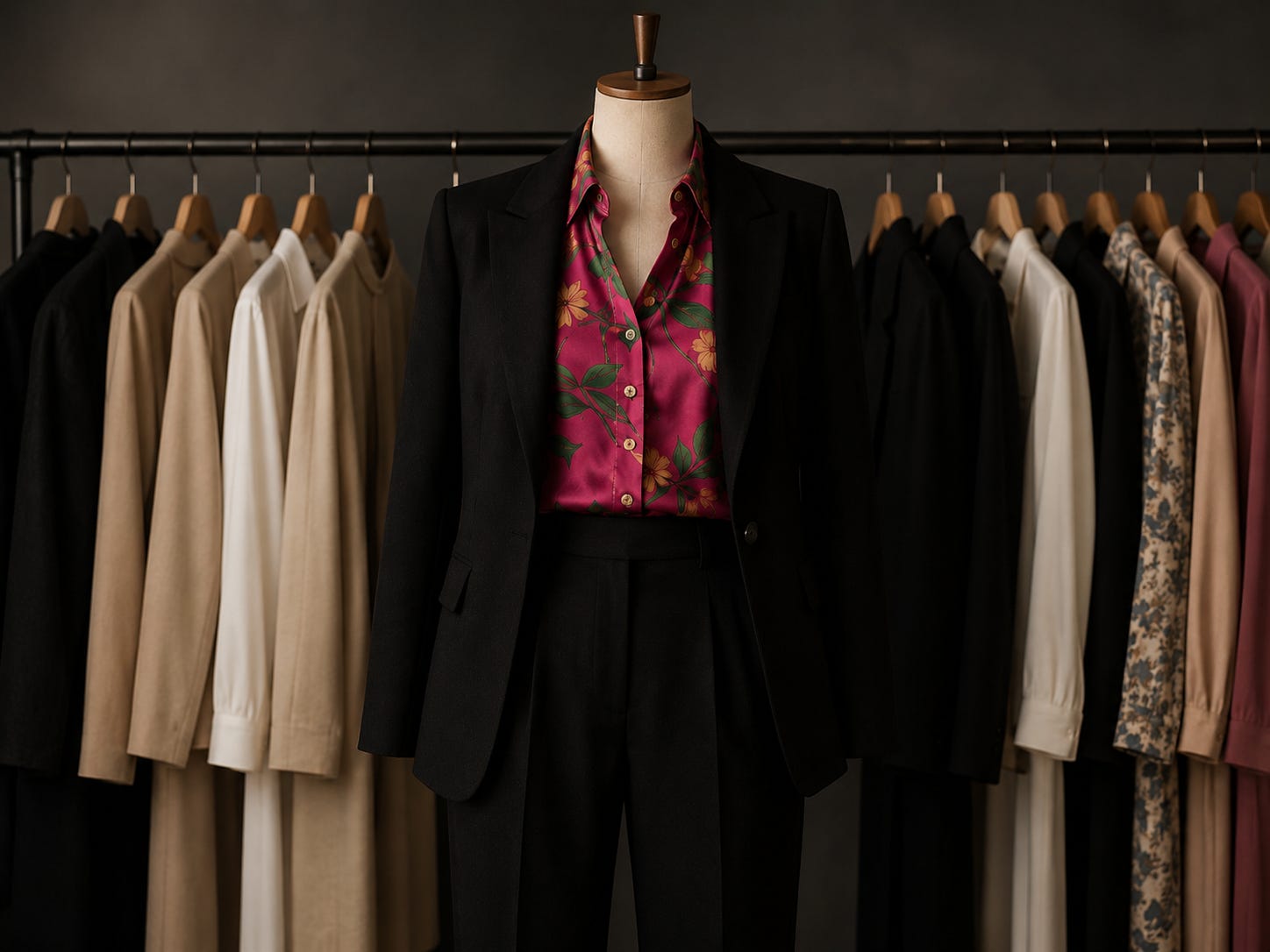
One blouse she showed me was made from high-quality satin: cool to the touch, with a rich, deep lustre that shifts naturally in the light. It was bright pink, with a green and yellow print, gold buttons, and puffy sleeves. It was the kind of garment designed to attract attention on a rack.
The problem was not its quality.
The blouse had no place and no method.
Most of her wardrobe had been assembled in the same way. She chose pieces according to her mood. Some belonged to imagined occasions. Others appealed to her because they looked unusual. Fancy prints and unexpected details had become proof that she possessed a unique personality.
She had built a collection of attractions, but not a wardrobe.
The life behind the clothes
She worked in a corporate environment, but she had romanticized clothing so much that she had forgotten its functional and symbolic roles.
Clothes were expected to delight her, express her mood, and make her feel different. They were not expected to create restraint, order, or professional credibility.
Being competent has little to do with owning a navy-blue blazer. Still, presentation says something about professional ethos. An incoherent image can suggest impulsiveness or a lack of self-reflection, even when the person is intelligent and capable.
The way someone shops often reveal the gap between self-perception and real life. In her case, she wanted a cohesive image but continued buying clothes as isolated emotional experiences.
Before she bought something new, I began by asking her a simple question: “could you imagine at least four outfits in which the piece would work?”
She could not.
That question interrupted the fantasy of the isolated object. A garment could no longer justify itself through beauty, novelty, or love at first sight. It had to participate in something larger.
When personality becomes costume
People who lean toward romantic or whimsical styles often confuse a good wardrobe with a collection of individually interesting clothes.
They fear that classic pieces will make them conformist or boring. Taken to an extreme, minimalism can certainly look lazy or unfinished. But well-assembled simplicity does not erase personality. It gives personality a clearer form.
That was the hard truth in her case.
She did not need less personality in her clothes. Her personality needed structure.
The bright satin blouse finally made sense when I placed it under a classic black blazer and paired it with black, high-waisted straight-leg pants and black leather mules.
Nothing about the blouse had changed. Yet it looked more expensive, more deliberate, and more personal. The surrounding clothes gave it authority.
She did not need to resemble a curiosity shop mannequin to feel like herself.
That combination opened the door to a different way of seeing. She began to think in terms of color relationships and silhouette pairings instead of judging garments one by one.
Elongated lines brought order to her outfits and harmony to her body. Removing ruffles and competing details did not make her dull. It allowed people to notice her before they noticed the performance taking place on her clothes.
The line between personality and costume appears when the clothes become the focal point of someone’s presence rather than one part of the person as a whole.
Technically correct, personally wrong
This is why image consulting cannot begin and end with body types and seasonal palettes.
Those systems are useful, but they are resources rather than commands.
This client’s coloring contained a great deal of gray and favored muted colors. Her temperament, however, was cheerful and energetic. Dressing her in gray from head to toe might have created harmony around her face while contradicting everything alive in her presence.
A flattering color can still create the wrong image.
I learned this through my own color analysis. Yellow appears in my palette. It is technically correct and personally wrong.
The color is tied to experiences I do not enjoy: fast food and being under the sun. I dislike the first, while the second burns my skin and overwhelms my eyes. My temperament is not sunny nor upbeat.
Purple and blue serve me better because they convey depth, strength, and reflection.
A palette is permission, not obligation.
“This color suits your skin” and “this color suits you” are different statements.
A color may improve the appearance of your complexion while making you feel disconnected from yourself. When you cannot find anything positive in seeing or wearing it, technical correctness is not a good enough reason to build an image around it.
The same applies to silhouettes. A cut may follow every conventional rule for a body type while emphasizing a quality the wearer does not want to communicate.
Clothes do not exist only to make a body look slimmer, taller, or more proportionate. They also need to serve the person’s purpose.
Learning to embrace boredom
For many clients, this means learning to embrace boredom.
Not every shopping experience should feel like walking through a field of roses or an adventure trip. Most of the time, shopping is a transaction. You identify what is missing, find the best available version, pay for it, and leave.
The black knee-length pencil skirt that works with ten different blouses may look unremarkable among twenty other black skirts on a rack. Its value becomes visible through dress.
Classic pieces are called classic for a reason.
They support clothes that cannot support themselves.
Dependable clothes may look disappointing in the store because they are not designed to win attention in isolation. Their strength appears over time, through fit, repetition, styling, and the presence of the person wearing them.
This requires giving up the idea that every purchase must provide emotional rescue or personal reinvention.
Shopping is not therapy.
Clothes cannot be expected to discover a self that has not yet been examined.
Consistency sounds boring only when it is confused with conformity. Conformity means acting out of inertia. Consistency is deliberate. It comes from knowing what works and choosing to repeat it, not because repetition is exciting, but because it makes your message clearer. Embracing boredom means accepting that not every choice has to feel new in order to be effective.
The person becomes more legible
Her image became more distinctive when she stopped forcing every piece to be distinctive.
The blouse remained bright. The vintage pieces remained part of her wardrobe. But they were given rhythm, restraint, and a place within the life she was living.
The clothes came last because first she had to change her beliefs about clothing and her definition of herself.
She had to understand that uniqueness does not come from unusual cuts, bright colors, or collecting things other people would not wear. It appears when the body, temperament, and values of a person are reflected through their presentation.
I can technically wear yellow. She could technically wear gray. Neither fact tells the whole truth.
Good image consulting does not turn every available resource into an instruction. It selects what serves both presence and purpose.
The best clothes do not make the person disappear behind them.
They make the person more legible.
Clothes are one tool for building presence.
They are not presence itself.