

Beauty Is Not Morality, but It Still Has Consequences
Why the pursuit of beauty is not vanity, and why pretending it does not matter is dishonest

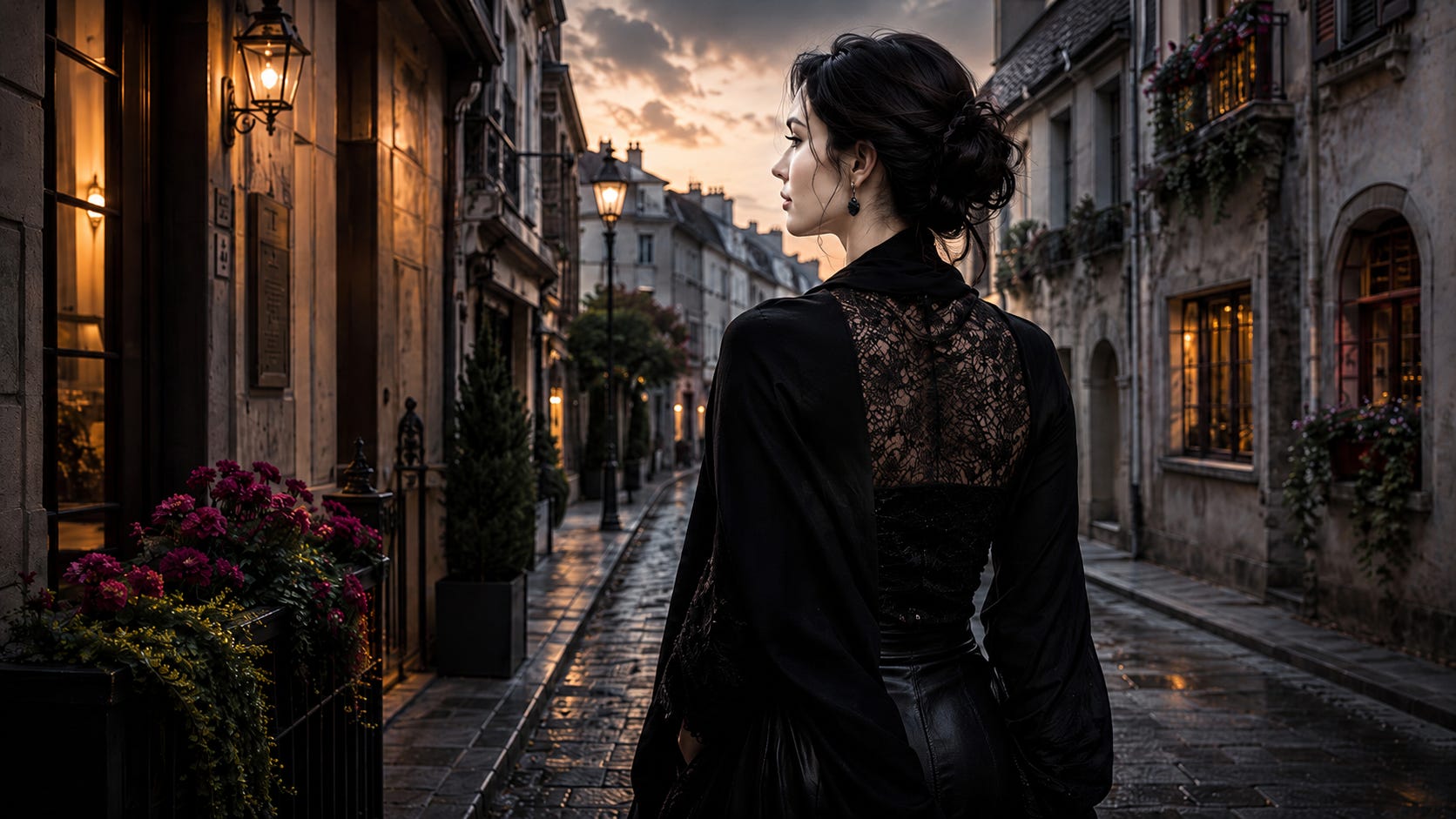
Beauty has acquired a strange moral burden. We are expected either to worship it or to pretend not to notice it.
One side treats beauty as evidence of worth. The other behaves as though admitting that beauty affects us is a character flaw. Both positions are childish.
A beautiful person is not necessarily a good person. A beautiful building is not always a humane one. Good taste does not confer virtue, and an attractive face tells us nothing reliable about the character behind it.
History makes this distinction clear. The Nazis did not lack an appetite for art. They looted cultural property on an extraordinary scale. Hitler established a special commission to assemble works for the museum he intended to build in Linz, while Hermann Göring took a keen personal interest in art and amassed a private collection numbering in the thousands.12 The ability to recognise, covet and surround oneself with beautiful things did not make these men less monstrous.
Beauty is not morality. But it still has consequences.
We look. We remember. We respond.
Research into physical attractiveness has repeatedly found what polite conversation often prefers to deny: appearance influences how people are treated. Economists Daniel Hamermesh and Jeff Biddle found earnings differences associated with perceived attractiveness even after controlling for demographic and labour-market characteristics.3 An experimental study of bargaining found that attractive participants did not themselves make systematically different offers or demands, but were treated differently by others.4 An observational study of criminal defendants found that attractiveness predicted the severity of both minimum and maximum sentences in its sample, with more attractive defendants receiving less severe sentences.5
None of this means that beauty determines anyone’s fate, nor that every study finds the same effect in every context. It means something simpler: pretending appearance has no social consequences is untenable. We can decide that some of these consequences are unfair. That does not make them unreal.
Beauty acts on us
A beautiful person can change the atmosphere of a room before saying a word. There is an aura to someone who is healthy, well cared for, well dressed and at ease in their own body. Other people perceive it. They become curious. They look longer. They may become more open.
The same principle extends beyond the human body.
I know what happens to me when I enter a home in which the furniture is proportional to the space, the colours respond to the natural light, the materials are pleasurable to touch and the air smells good. My mind settles. My thoughts flow more easily. There is less visual friction competing for my attention.
This is not about filling a house with expensive objects. Expense and beauty are not synonyms. A handcrafted table invites a different relationship from something designed to be discarded. We tend to care for objects that appear worthy of care. We repair them, protect them and pass them down.
The principle scales outward. A city that restores what it inherited, maintains its streets and refuses to treat vandalism and decay as inevitable tells its citizens that their surroundings are worth caring for. What we consider worth making beautiful, we are more likely to consider worth maintaining.
For too long, beauty has been treated as either a luxury or a form of vanity. Utility became sufficient. Ornament became suspect. Craftsmanship could be sacrificed because the cheaper object performed the same function. Caring about one’s appearance became suspect, while insisting that standards themselves were harmful acquired the appearance of moral seriousness.
Effort became vanity, standards became oppression, and indifference was reframed as humility.
Some strains of contemporary body-positivity and aesthetic relativism began confusing two very different ideas: that every person possesses human dignity, and that every body or aesthetic choice must therefore be described as beautiful.
These are not the same thing.
Human dignity does not require aesthetic dishonesty
A person can deserve respect without everyone being required to find them attractive. We can oppose cruelty without abolishing judgment. We can acknowledge differences in health, proportion, grooming and harmony without believing that those differences determine anyone’s human worth.
Once we become afraid to make aesthetic distinctions, however, cultivation itself becomes difficult. If everything is equally beautiful, there is nothing to learn. No eye to train. No standard to aspire to. No reason to understand proportion, colour, fabric or craftsmanship. No reason to improve anything.
Beauty, as I understand it, is not a fixed template to which every person must submit. Research into facial attractiveness suggests that judgments involve a mixture of recurring cues—including symmetry, averageness, sexually dimorphic characteristics and cues associated with health—alongside substantial individual and cultural variation.6 Beauty is neither infinitely objective nor infinitely subjective.
But beauty also requires something more difficult to quantify: coherence.
A person can satisfy every fashionable marker of attractiveness and still look wrong. The face may be beautiful. The clothes may be beautiful. The hair may be immaculate. Yet the whole does not belong to the person.
We perceive that dissonance.
This is where the pursuit of beauty separates itself from vanity
Beauty as cultivation asks you to look closely at what is already there. Vanity asks you to escape it.
Vanity refuses age, structure, limits and sometimes identity itself. It wants the face currently rewarded by the algorithm, the body currently rewarded by Hollywood, the features currently repeated so often that people who began with entirely different faces somehow end up resembling one another.
We can see the consequences around us: increasingly young people altering faces that had barely finished becoming their own, often in pursuit of features rewarded by algorithms rather than features that belong to them with coherence. We see older people pursuing youth until their faces cease to carry the passage of their lives.
That is not liberation through beauty. It is dependence.
An angular face does not need to become round and soft in order to become beautiful. A woman on the other side of forty does not need to reconstruct her twenty-year-old face in order to remain desirable. A fit adult does not become younger, more interesting or more attractive by dressing like a teenager.
Beauty does not require you to become somebody else. At its best, it makes you more legible as yourself.
I had to learn this personally.
For years, I received the kind of advice given to women whose natural appearance makes other people slightly uncomfortable: lighten your hair, wear beige, tone down the makeup, soften everything.
The problem was that I was built for cool intensity.
My colouring is high contrast. Black does not drain me. The darkest shades can become almost radiant against my skin, particularly with silver and a saturated fuchsia lipstick. Leather and lace remain with me from the gothic dressing I loved when I was younger, but they no longer need to turn me into a costume. They became materials I could carry into adulthood.
Long before I understood colour analysis, I disliked nude makeup. I could not explain why an aesthetic routinely presented as natural made me feel less like myself.
Later, spending time in Andalucía gave me another piece of the puzzle. I felt an aesthetic familiarity there that I had rarely experienced in the everyday feminine ideals surrounding me at home. Perhaps some of that recognition is connected to my own Andalusian ancestry. I cannot prove that connection. I just knew that something felt familiar.
The important thing is that I did not become more attractive by learning how to disappear. I became more attractive by learning how to see what was already there.
Once I stopped toning myself down, I stood differently. I became more visible, more sensual, more authoritative and more at ease. People responded differently too.
Some of the wrong people disappeared from my life. Others entered it. Conversations changed. I found myself increasingly drawn towards people interested in ideas, ideals, culture and meaning rather than endless discussion of retail, trends, and social media.
I do not believe that dressing well magically summons more interesting people. I believe something subtler happens when you stop disguising who you are: compatible people can recognise you more easily, and incompatible people may find fewer reasons to remain.
This is why I consider the pursuit of beauty a form of cultivation.
You owe that cultivation first to yourself: to become stronger, to stand tall, to care for your body, to understand your face rather than wage war against it. To learn which colours make you appear alive. To recognise good fabric beneath your fingers. To know the difference between harmony and conformity.
None of this requires enormous wealth.
You can walk. You can train your body at home. You can groom yourself with inexpensive products. You can learn. You can observe. You can maintain what you already own instead of constantly replacing it.
Money buys access and convenience. It can buy extraordinary clothes, art and furniture. It cannot buy discernment.
There is a reason conspicuous expense so often fails to produce elegance. Without study, more money makes bad taste more expensive. Cultivation requires attention before it requires consumption.
It also extends beyond the self.
Craftsmanship preserves techniques carried through generations. The decision to maintain an inherited object rather than replace it with something disposable can preserve family history. A city protecting its architectural heritage expresses pride in its culture and affection for its homeland.
A cared-for home is not a backdrop for photographs. It makes people comfortable enough to stay. Friends sit longer. Families gather. Conversations happen. Memories attach themselves to rooms.
Dressing with care for a wedding tells the couple getting married that their special moment deserves your effort. Dressing with care for a funeral tells the grieving that their loss is larger than your convenience.
These acts do not make the person performing them virtuous. But they can still be good.
That is the distinction I think we have lost.
Beauty does not prove goodness. But contributing beauty to the world can be an act of care.
There is also responsibility in exercising aesthetic judgment.
Public things should be judged publicly. Architecture, advertising, fashion, art, urban design and cultural trends belong to the common conversation. Freedom of expression includes the freedom to say that something is ugly, badly designed, disproportioned, or destructive to its surroundings.
With individuals, judgment requires more discernment. If someone close to you is making choices that affect their health, their opportunities, or the life you share with them, honesty can be an act of care. When aesthetic judgment is part of your profession, flattery is a dereliction of duty. You should be able to discuss proportion, health, harmony and coherence without pretending that every choice works equally well.
But calling a stranger ugly on social media is not cultivation. It is vulgarity.
Taste without manners is not taste worth having.
The pursuit of beauty demands more from us than criticism. It demands courage, because becoming visible can be frightening. It demands determination, because cultivation takes time. It demands discipline, because health, craftsmanship, knowledge and maintenance do not happen by chance. It demands discernment, because more is not always better.
Above all, it demands honesty
When you pursue beauty while remaining faithful to your history, your features, your character, your age, and even your ancestry, it becomes an act of elevation, not vanity.
I think again of all the things I was once told to soften.
The black that was supposed to overwhelm me. The contrast that was supposed to be reduced. The leather and lace I was expected to leave behind with adolescence. None of them needed to disappear. They needed to be understood.
Perhaps beauty often begins there: not with acquisition, correction or transformation, but with recognition.
The same instinct makes someone restore an old building instead of demolishing it, repair a table instead of replacing it, or preserve a technique that would otherwise vanish with the generation that mastered it. You look at what is already there. You understand its character. You decide it is worth caring for.
Beauty should not remain a distant ideal, confined to museums, palaces, fashion photographs, or cities we visit once in our lives.
Sometimes it is much closer than that.
It is the face you stopped trying to erase.
The object someone chose to repair.
The building someone decided was worth saving.
Beauty will never make us good. But choosing to see it, cultivate it, and preserve it may still be one of the ways we show that something in this world is worth our care.
Latham, E. “T.” (n.d.). Conducting research at the National Archives into art looting, recovery, and restitution. U.S. National Archives and Records Administration.
United States Holocaust Memorial Museum. (n.d.). Hermann Göring. Holocaust Encyclopedia.
Hamermesh, D. S., & Biddle, J. E. (1994). Beauty and the labor market. American Economic Review, 84(5), 1174–1194. https://doi.org/10.3386/w4518
Solnick, S. J., & Schweitzer, M. E. (1999). The influence of physical attractiveness and gender on ultimatum game decisions. Organizational Behavior and Human Decision Processes, 79(3), 199–215. https://doi.org/10.1006/obhd.1999.2843
Stewart, J. E., II. (1980). Defendant’s attractiveness as a factor in the outcome of criminal trials: An observational study. Journal of Applied Social Psychology, 10(4), 348–361. https://doi.org/10.1111/j.1559-1816.1980.tb00715.x
Little, A. C., Jones, B. C., & DeBruine, L. M. (2011). Facial attractiveness: Evolutionary based research. Philosophical Transactions of the Royal Society B: Biological Sciences, 366(1571), 1638–1659. https://doi.org/10.1098/rstb.2010.0404